Sunday, April 10, 2011

Inquiry Lesson - How are Landforms Created?

For my structured inquiry, students investigated plate boundaries.  Given a specific set of questions, students began by independently researching information about plate boundaries.  Students recorded information in their science journals.  Next, students were placed in groups.  Together they shared their research and corrected misconceptions.  After each group felt they had thorough and accurate data, they electronically completed and submitted a data chart.  The next step of the project was to choose one boundary type and make a model of a landform that occurs at that boundary.  Students completed their models in groups.  Finally, each group presented a model and lead a class discussion about the landform and boundary where it occurred.

Students were very enthusiastic about this project.  Students really seemed to like the idea of gathering their own information which translated into them taking control of their own learning.  Students also liked the idea of being able to verify their information by working cooperatively with other students.  Of course, students were very excited about making their clay models!  They did such a great job.  The assessments I used included an observation checklist, questioning, journals and grading rubrics.  These assessments allowed me to see student learning and provide feedback.  I felt student learning was evident throughout the project, especially when I listened to groups using new words they had learned from their research.

The following are examples of student work.  The first sample is a completed boundary chart.  This sample shows student learning as all information is provided and all directions have been followed.


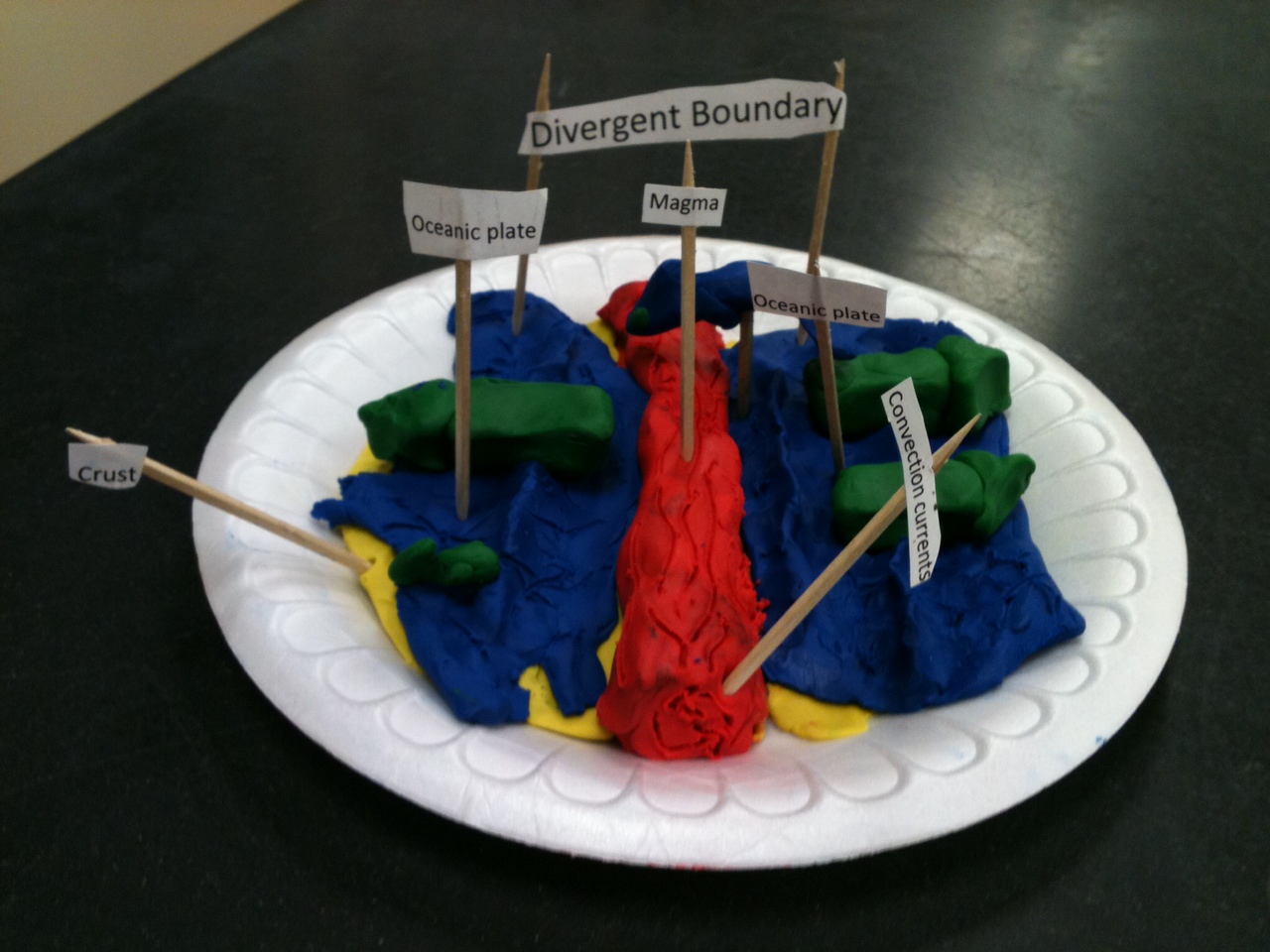
The following are pictures of students' models.  These models are an example of student learning because students had to create models of land forms created a specific boundary types.

                                           Volcano formed at convergent boundary.


                                           Sea-floor spreading at a divergent boundary.

I really like that students include convection currents in their models!  They really enjoyed this part of the lesson.  Overall, I am very pleased with how the lesson was carried out, and I am very proud of my students!

Sunday, March 20, 2011

Melting Icebergs

Melting Icebergs Experiment

The experiment we did in the lab “Melting Icebergs,” shows what would happen if the ice at the North Pole melted.  The ice at the North Pole is floating on water so it has already displaced the volume of the ice in the ocean.  If the ice melted, the oceans would not rise. 

On the other hand, the ice at the South Pole covers Antarctica.  If that ice melts it will cause ocean levels to rise.  Scientists believe that Antarctica is covered with about 90% of Earth’s ice which, if melted, could cause the oceans to rise about 200 feet.  Since the average temperature in Antarctica is -37°, most scientists believe that this meltdown will not occur.

If I were doing this experiment with my students I would certainly expect them to spend time researching both sides of the global warming issue.  Although most scientists agree that the atmosphere is warming, they do not all agree on the cause.  A look at ancient climates might be valuable to determine how shifts in climate have occurred in the past.

The other question I would ask my students is, how can we perform a second experiment to model what would happen if the South Pole ice cap melted.

I have had a bad health week so I am signing off for now!  Have a good week!

Sunday, March 13, 2011

STEM Lesson Plan Reflection

This blog was created to allow me to reflect on my experiences as a science teacher and as a graduate student at Walden University.  I welcome your comments and questions.

This reflection is regarding my STEM strategies lesson plan created for my Nature of Science course at Walden University.  The 5 E’s strategy that is:  engagement, exploration, explanation, elaboration, and evaluation is helpful in planning lessons because I helps create a lesson that is complete and considers all parts of the lesson from beginning to end.  It is very similar to the methods I used when I was an undergraduate education major.

Currently, I teach three subject, 7th grade math, 7th grade science, and 8th grade science.  In the past I have also taught 8th grade math.  I am fortunate to have a SmartBoard, so all my lessons are prepared in advance.  Of course, after teaching a lesson, I often go back to change any area where I find student misconceptions.  It is not very realistic to think that a teacher could utilize a template such as the one we were required to use for this lesson plan for every lesson. However, as you get to know your students and as you become a more experienced teacher, you begin to be more successful with engaging students in a new lessons or making sure that you are extending student thinking.  It is never a bad thing to go through the process of completing some formalized lesson plans to ensure that you are not taking short cuts in your classroom presentations.

The lesson plan I created primarily deals with students evaluating Earth’s four systems and how those systems interact with each other.  Students will use the Deepwater Horizon oil spill to help them use a real-world problem for their exploration.  On a secondary level, the lesson deals with how human activity impacts the environment and finally, how we weigh the benefits/costs of things like oil drilling.  The biggest logistical issue I may face in presenting the lesson is getting time in the computer lab for the elaboration activity.  We have two computer labs in our school, but they are heavily used by our language arts department.

Finally, I would like to share two websites that I used to obtain information to use in the engagement and elaboration parts of my lesson.  The websites are:

Smithsonian Education - http://smithsonianeducation.org
Teachers’ Domain - http://www.teachersdomain.org
Smithsonian Education has a variety of interesting lesson plans that meet national content standards.  Teacher’s Domain has a wonderful array of digital media, movies, slideshows, and animations that I often include in my daily lessons.
Thanks for reading my first blog.  As I mentioned before, I welcome your comments!